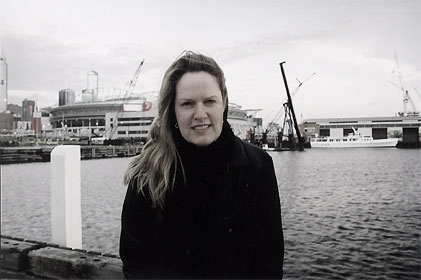
The Artist


"Imagination is more important than knowledge. Knowledge is limited. Imagination encircles the world."
Albert Einstein

Bio


Melbourne docklands precinct, 28th September, 2002

I was born in Melbourne, Australia, in 1963 and live there in an inner city suburb with my partner Demetrios [ also an artist ] and my Budgie
Norman [ know as the "Hubster" for reasons we do not understand]. We now have a cat which is interesting as we are not "cat" people, she is a refugee, my Dad's pet, and as he passed away this June 2003 she was homeless. We are still not "cat" people and though she is attempting our transformation it won't work.
The work depicted on this website includes my full oeuvre dating back to 1988 when I seriously began to entertain an artistic path.
To live and find work in Melbourne is easier on humans than perhaps in other cities. It is generally very pretty with some interesting muscular industrial areas. Gardens and tree lined streets were designed in during town planning and we take greenery and foliage very much for granted here. The climate is great, if you enjoy a distinct 4 seasons [ sometimes all in one day ], which I do, the winters also are very kind, no snow except in the hills, the odd frost will be all you'll suffer so during winter a decent 3/4 length coat is all you might need. Currently [ October 2002 ] a mean drought has set in throughout the eastern states and the countryside is looking under considerable stress, farmers and country towns are suffering [ it is only mid Spring ]water restrictions are not far off even for the larger cities. New South Wales [to Melbourne and Victoria's north ] has had its first bush fire, it is a tinder box out there. Melbourne is a walkable city with a mostly friendly population that loves to have the odd international visitor around to show off to. The gallery scene is much more vibrant when ventured off the commercial strips. Grab a copy of "The Art Almanac" upon arrival, it has maps and most of the galleries in Melbourne advertise in it. Lookout for the "artist run" spaces. The National Gallery of Victoria is not due to reopen until 2003 when the long planned refurbishment is finished. We are all missing it. The Melbourne Museum is definitely worth a look and the Zoo has undergone such a transformation in philosophy and structure that I'm not too unhappy to recommend it being visited as well. Trams make it easy to get around the inner city and there is good public transport via trains and buses for everywhere else. The bay is always nearby, make sure to take in the west coast, hire a car and drive it if you can, and the food; restaurants, cafes, don't forget the coffee - just about anywhere in Melbourne, is very special.


USA TRIP 2002- see the pictures and diary


Artist's Statement

The art establishment of Melbourne and indeed Australia does not take seriously art of the Surreal and Fantastic. The genre is generally dismissed or worse identified with fantasy art. What is accepted and promoted generally is art that defines [ for some ] the psyche of this nation. The auction houses [ and even the art Museums ] here are dominated by bush scapes, bush outlaws and "folklorique genre" [ a description coined by Robert Hughes* ] paintings. And, where there should be opportunity such as in the art fairs we find them to be dominated by commercial concerns alone. The true "Avant Guard" are further marginalised within what is an increasingly shrinking market base."Colour-Expressions" in paint are big favorites in the commercial galleries; a form of "Neo-Modern Decor Art" being the measure for what passes as art. Muddy urban allegories, a form of the bush tale, are also popular. Multimedia works that are substanceless are churned out by design hacks and because the medium is new and technical their works are found interesting and labeled "avant guard". Some of it is very good allot of it is just wall paper created with easily applied filters. The content and purpose of art is many things, it is instructive, beautiful, challenging but above all it exemplifies the human desire to understand and pronounce its very existence. The idea that in amongst this should also sit big swirly colourscapes or patterned and textured monochromes diminishes the role art has, waters down its meaning to us until we are left with homogeny and mediocrity. Some of this "art" is merely design industry decor and this needs to be seen for what it is, attractive design and that is all. "Retro" is a hugely popular thematic aspect to the decor driven impostors. It is finding a market though, the design house has infiltrated the art sector and that is of concern, because it is not a market worth supporting in terms of the advancement of art and its true practitioners. After all there are only so many big [ has to be big or it can't be good ] swirly colourscapes you can look at before you get bored and wander off. The reality is that a whole new type of gallery visitation is being cultivated, based upon fad and fashion, that has little relationship to what art is all about. The real artists and their art will disappear and the decor drivel, that many find so appealing initially but soon tire of, will remain.
Art of the imagination knows no borders or boundaries designated by fashion, fad or parochialism, great art of the imagination therefore remains relevant whatever the time.

The following is a letter written to The Editor, The Age newspaper (Melbourne's broadsheet) published in the letters section on Sat 14th Dec 2002. The art work in question was in my opinion intellectually lazy and fairly pointless.

"State of the Art?"
"This years Turner Prize's winning entry "The Thinker" by Keith Tyson, will come as no surprise to many struggling fine artists. Quality of idea, including its conception and delivery are out of favour in contemporary art circles throughout the world. When you have no idea or talent you plumb the depths of your minimal experience and "borrow" the excellence of others.

What is disheartening, disgusting and soul destroying is that the purported art "intelligentsia", the collecting institutions, the commercial art sector and the art market lap it up and perpetuate the myth that this is the art of our times. All contribute to the ongoing aggrandisement of what is little more than design orientated window dressing and commit to obscurity those truly deserving of acknowledgment. The art lover, the collector and the public via their art institutions have a diminished and diminishing experience as a consequence. The critic too has their role in perpetuating this state of affairs with slavish attention paid to only those exhibitions where their own reputation, or that of the publications they write for will be served.

Thus art, artists and the art lover suffers from an impenetrable clique of self-serving mediocrity."


and this one published... in July 2000 - when just too much sport simply wasn't enough for the media and public in the post Olympic glow.....

"The elite sports women and men in this country enjoy high status. Their efforts to attain excellence are equated with all that is good and praiseworthy. By its very nature, sports is elitist. However, these same striving and goal orientated attitudes are discouraged and disparaged in the arts and academia. Sadly, our community and even our leaders differentiate between innate elitism in sporting excellence & excellence in academia. Why is it that the pursuit of excellence is lauded and supported in sports, but viewed with suspicion when it emerges from within the intellectual and arts sectors? Surely the contradiction is obvious?

For a person to be labelled an "Elite" practitioner of the sport in which they excel is high praise indeed. Their "elitism" is seen as a contribution to the world bank of human endeavor. Jane Flemming is an elite athlete, who as a recent somewhat curiously chosen spokesperson for the arts community, stated that the challenge for artists was to make themselves (and presumably their art) more accessible and therefore more relevant to the community, less "elitist". Yet were her philosophy to be applied to sports, then the Olympics, as a case in point, would never have selection trials; they are elitist.

So, lower the hurdles, reduce the track and swimming times and force the athletes to comply so that we are all able to compete at an 'elite' level so as not to feel alienated or excluded. The implication is that for our artists and intellectuals those "hurdles", "bars" and "times" must be lowered, they must "dumb down" so the rest of us do not feel threatened. Most of us at some stage in our lives have been faced with the realisation that we do not measure up in some way. Perhaps in the area of physical pursuits it is easier to measure excellence and therefore easier to concede we cannot compete.

Measuring the scales of excellence for the arts and academia is a little trickier, who comes First, Second and Third? I would argue that the whole community benefits from this type of 'race', relevance is not an issue. Exclusion is only in the mind, participation is always available. Academia and the arts communities could use a shake or two certainly, not to reduce that potent drive for excellence but to promote it with the open passion and honesty exemplified by the sports community."


Inspirations & Technique
I work in oils on canvas and I am largely self taught with a little formal technical training. Along the way I have greatly benefited from the generous advice of artist friends and been inspired by many influences. Those influences are varied and are, in no particular order or preference; Remedios Varo, James Gleeson, Carravagio, Leonora Carrington, Dorothea Tanning, Jacques Louis David, Eugene Delacroix, Jean-Auguste-Dominque Ingre, Sandro Botticelli, Hieronymus Bosch....The list could go on and on. Inspired by these past greats plus the greats of the present and the future [ some of which I am privileged to include on my links page ] I hope to learn and contribute as much on my artistic journey as they have.

I paint essentially with the viewer in mind, hoping they are prompted to ponder more deeply on what the image might mean to them. If the viewer is challenged, all the better. [ Aesthetics are a consideration e.g: in terms of balance of composition, colour and tonal gradation, light and dark, etc. However, concerns about whether or not the painting will fit into the decor or sit well above the mantel are not ]. The works can become answers to my own questions, though an idea can emerge all from the imagination. Generally the ideas are an intellectual expression of how I view the world. I cannot simply paint what is there and attain satisfaction from the effort. However impressive might the result be, it is not enough. It is the idea upon which for me pivots meaning and purpose, not forgetting that the success or failure of a painting can depend on its technical execution. I combine a kind of fresco technique with tonal realism, working up the surface of the canvas in layers. I use my own photography; of models, objects or scenes in order to accurately reference all the elements of an idea that are represented within the composition. A kind of referenced collage helps me piece the idea together. Sometimes I will have the idea first then search for the elements to reinforce what the imagination has produced. Often the elements I have collected will themselves suggest an idea. There is no rule here. The only constant is that it does not come easily and many compositions are rejected, or reworked over and again. Sometimes it all just comes together and you get a rush of satisfaction that is hard to describe, those are the experiences you hope for when painting. Oh, and yes, it doesn't hurt your inner artistic growth to sell the odd canvas now and then either.


*In
his book Anything if Not Critical Robert Hughes used this phrase to describe French painters who traveled to Brittany to paint the Breton peasants. It is a phrase which I feel aptly describes the Australian artist who travels "outback" to paint the "real" Australia.